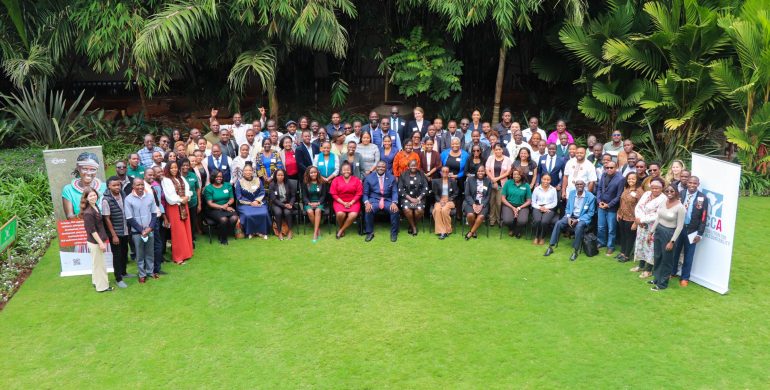
Pamoja Trust joined governments, businesses, civil society organisations, and development partners from across East and the Horn of Africa at this year’s Business and Human Rights Dialogue, convened by DanChurchAid under the theme “Beyond Compliance: Strengthening Accountable and Rights-Centred Supply Chains in East & Horn of Africa.” Building on the momentum of the inaugural 2023 Kampala conference, the two-day dialogue brought the region’s most pressing human rights and business conduct questions into one room — and Pamoja Trust was there to make sure the voices of affected communities were part of that conversation.
As a partner in convening the dialogue, Pamoja Trust co-hosted a breakout session under the EU- and Danida-funded Cultivating Justice project — delivered jointly with DanChurchAid and CEPCJ — titled “Unlocking Access: Agribusiness, Remedy, and Multistakeholder Dialogue in Kenya.” The session was led by Sally Miruri of Pamoja Trust.
The session opened with a hard truth drawn directly from community experience: land-related grievances sit at the centre of most of the harms agribusiness investment generates. When land governance is weak, the consequences cascade — land conflict gives way to lost livelihoods, labour vulnerability, environmental harm, and, ultimately, community grievance. These aren’t isolated incidents. They trace back to unresolved questions of land tenure, participation, and benefit-sharing.
A central image from the session was the “justice gap” — a funnel showing how harm narrows as it moves toward remedy. Many people affected are never even identified; of those who are, most never see their grievance resolved. Pamoja Trust’s message was direct: access to remedy has to start long before a grievance is ever filed. Strong social safeguards — secure land rights, meaningful participation, real consultation — are the first and most effective line of defence against harm, not an afterthought to it.
Rather than treating formal grievance mechanisms as the only path, the session made the case for a multi-door approach to justice — one that recognises judicial, administrative, community-based, customary, and non-judicial mechanisms as complementary, not competing. For communities navigating land disputes, the fastest route to remedy is often the one closest to home.
The breakout’s roundtable discussions surfaced sharp, practical insight from across sectors. Participants agreed that the greatest harm in Kenya’s agribusiness sector falls on local communities, smallholder farmers, and workers — and that closing the access-to-remedy gap requires grievance mechanisms that build on structures communities already trust, rather than imposing new ones from outside. On Kenya’s National Action Plan on Business and Human Rights, often cited as a regional benchmark, participants were candid about the gaps that remain: limited attention to youth economic inclusion, insufficient protections for children in agricultural value chains, and the ongoing challenge of turning policy commitments into action on the ground.
The session closed with a challenge to every actor in the room: the true test of responsible business conduct isn’t whether a policy exists, it’s whether people whose rights are affected can actually access remedy.
- For business: commit to grievance mechanisms people actually trust and use.
- For government: strengthen enforcement and coordination across remedy institutions.
- For civil society and development partners: invest in rights awareness, legal empowerment, and community participation.
- For all stakeholders: move dialogue from conversation to accountability.
Through the Cultivating Justice project, Pamoja Trust continues to work alongside communities, county and national government, and the private sector to put these principles into practice, pushing for home-grown, community-driven solutions to land and remedy challenges and ensuring that documentation of these gaps translates into real policy reform.