
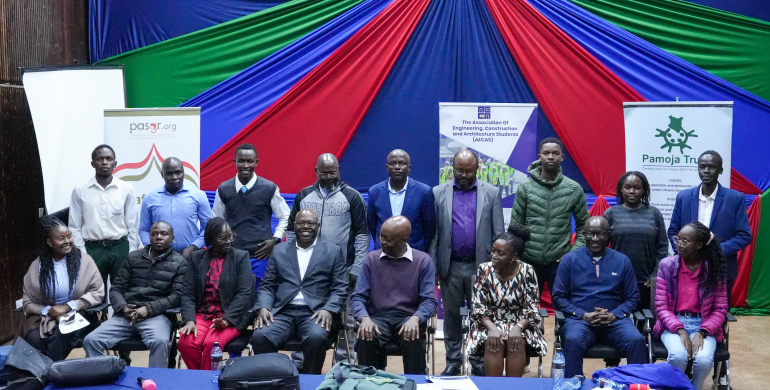
Pamoja Trust in collaboration with Partnership for African Social and Governance Research (PASGR) and the Association of Engineering Construction and Architecture Students (AECAS-TUK) hosted a public lecture on Mainstreaming Social Safeguards and Adaptive Settlement Planning in Built Environment Education and Practice at the Technical University of Kenya (TUK).
Organised under the Utafiti Sera House on Urban Governance and City Transformation, the engagement brought together students from planning, engineering, architecture, surveying, and environmental studies to explore how built environment education and professional practice can become more socially responsive and people-centred.
The public lecture forms part of Pamoja Trust’s ongoing work through the Utafiti Sera House on Urban Governance and City Transformation, which seeks to generate evidence and practical tools for embedding social safeguards into policy and practice.
Welcoming participants on behalf of the university management, Dr. Joseph Kedogo, Chairperson of the Department of Architecture, Design and Planning at TUK, underscored the importance of exposing students to inclusive and community-responsive planning approaches.
Delivering the keynote address, PASGR Executive Director Prof. Fadel Ndiame reflected on the role of academia, evidence, and social safeguards in shaping inclusive development practice across Africa. He noted that rapid urbanisation continues to intensify pressure on land, infrastructure, and service delivery systems, particularly affecting informal settlements through displacement, exclusion, and limited access to remedies.
The first session, Social Safeguards in the Built Environment, was facilitated by Eng. Lenah Mutheu, Engineer, Planning and Design at KURA; alongside Josiah Wandurua, Assistant Director – Social Safeguards at KURA.
Drawing from experiences in infrastructure implementation, Eng. Mutheu emphasised the importance of integrating social safeguards throughout project cycles and highlighted how projects may face delays, resistance, or failure when issues of participation, livelihoods, displacement, and inclusion are not adequately addressed. Referencing experiences from various road projects, she demonstrated the importance of community engagement within infrastructure delivery. The session explored the role of social safeguards in infrastructure development, planning, housing, and urban transformation, with discussions centred on participation, livelihoods, inclusion, displacement, and community agency.
The second session, Adaptive Settlement Planning and People-Centered Development Approaches, featured Dr. Musyimi Mbathi from the University of Nairobi and Dr. Mildred Ambani from Kenyatta University.
Dr. Mbathi, an urban planner with extensive experience in participatory planning and informal settlement upgrading, explored adaptive settlement planning approaches and the importance of integrating lived community realities into urban development processes. Dr. Ambani, a planner, GIS expert, and lecturer in spatial planning and urban management, highlighted the role of stakeholder engagement frameworks and interdisciplinary approaches in strengthening inclusive planning systems.
The lecture created space for students to engage directly with practitioners and academics while reflecting on how future built environment professionals can contribute to socially responsive and inclusive development practice.